misc_functions
angle Function
- class gcodeBuddy.misc_functions.angle(center_point, end_point)[source]
returns angle between line formed by two points and +x direction
- Parameters
center_point (list[int, float], tuple(int, float)) – point to be considered as the origin
end_point (list[int, float], tuple(int, float)) – point to form line with the relative origin point
- Returns
angle between line and +x axis, relative to origin point (degrees)
- Return type
float
Examples
# imports angle function
from gcodeBuddy import angle

# creating necessary parameter points
center_point = (2, 3)
end_point = (4, 5)

# returns 45.0
ret_angle = angle(center_point, end_point)
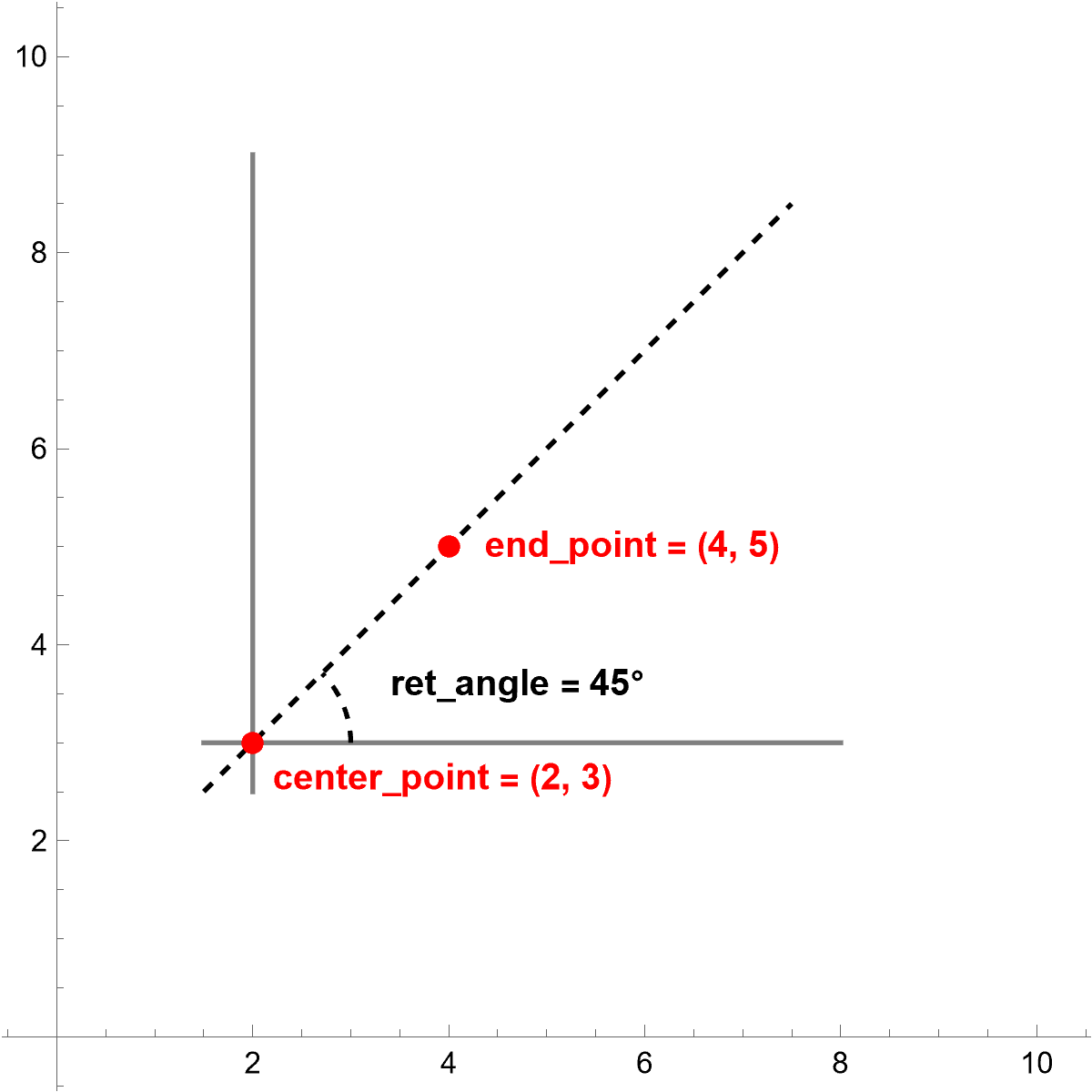
Visualization of angle() Example
centers_from_params Function
- class gcodeBuddy.misc_functions.centers_from_params(point_a, point_b, radius)[source]
returns two possible center positions of an arc given two points on arc and a radius
- Parameters
point_a (list[int, float], tuple(int, float)) – one of two distinct points on arc
point_b (list[int, float], tuple(int, float)) – one of two distinct points on arc
radius (int, float) – radius of arc
- Returns
two possible center point values
- Return type
list[list[int, float]]
Examples
# imports centers_from_params function
from gcodeBuddy import centers_from_params

# creating parameter variables
point_a = (2, 5)
point_b = (10, 5)
radius = 5

# returns (6.0, 8.0), (6.0, 2.0)
center_1, center_2 = centers_from_params(point_a, point_b, radius)
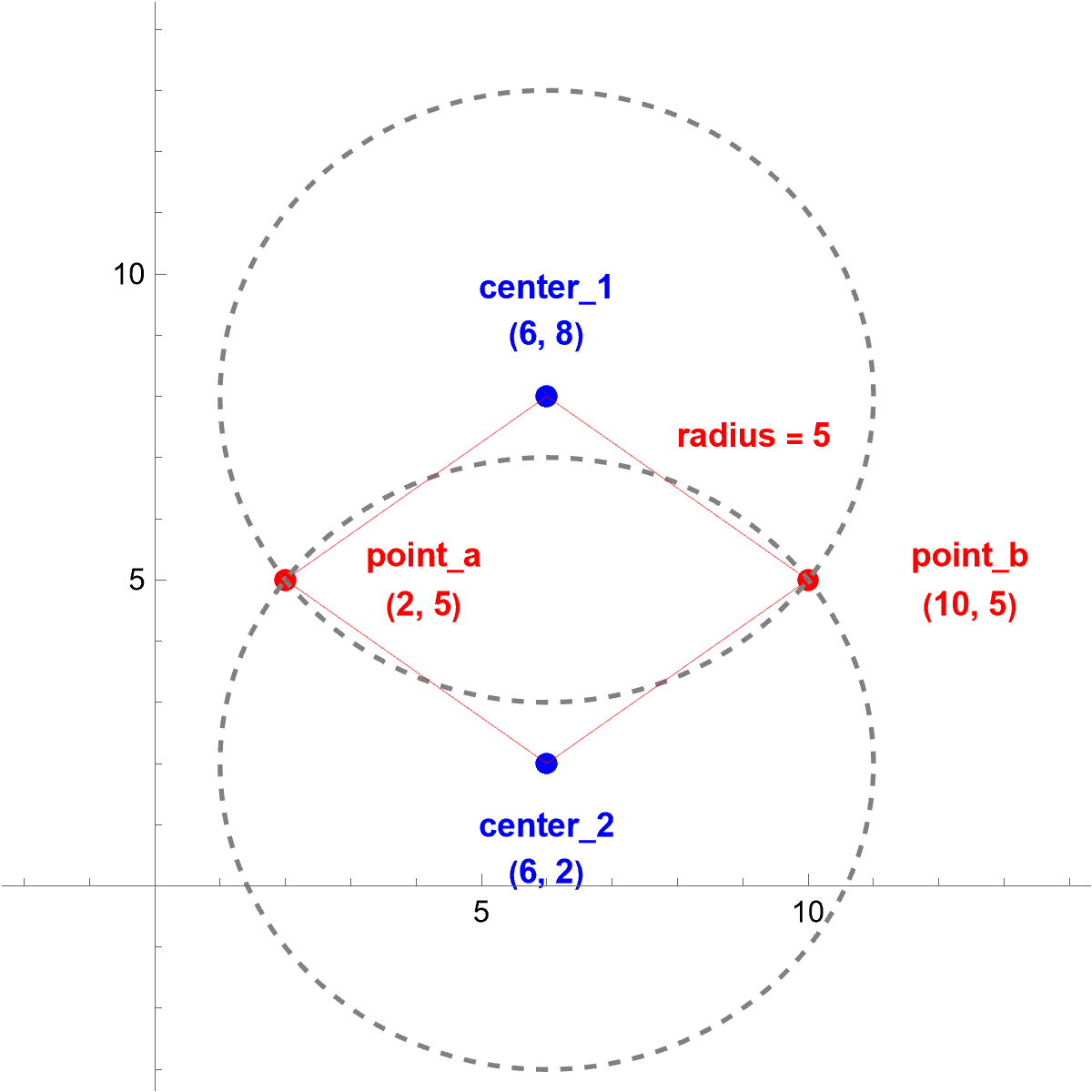
Visualization of centers_from_params() example
unit_convert Function
- class gcodeBuddy.misc_functions.unit_convert(value, current_units, needed_units)[source]
converts given value to specified units
- Parameters
value (int, float) – numerical value to convert
current_units (str) – current units of value
needed_units (str) – units to convert value to
- Returns
value in requisite units
- Return type
int, float
- Supported Units:
Position: “mm”, “cm”, “m”, “in”, “ft”
Speed: “mm/sec”, “mm/min”, “cm/sec”, “cm/min”, “m/sec”, “m/min”, “in/sec”, “in/min”, “ft/sec”, “ft/min”
Acceleration: Coming soon.
Examples
# imports unit_convert()
from gcodeBuddy import unit_convert

# returns 10.0
ret_val_1 = unit_convert(1, "cm", "mm")

# returns 12.0
ret_val_2 = unit_convert(1, "ft/sec", "in/sec")

# returns 29.6359
ret_val_3 = unit_convert(70, "in/min", "mm/sec")